
Why your brain can feel like a completely different place by 8 pm
Have you ever had a brilliant idea at 8 a.m. and wondered why, by 8 p.m., the same idea suddenly feels impossible?
Or maybe you’re the opposite. Your brain doesn’t seem to fully wake up until the afternoon, and suddenly you’re writing, planning, solving problems, and connecting ideas that felt completely out of reach that morning. You are rolling.
This is me. I am up pretty early every day. But I read, meditate, take my walk, eat a healthy breakfast, maybe clean the dishes, water plants. But I generally do not sit down to write or create until 11 am or later. I know for a fact that I am most focused, productive, and totally in the zone during the afternoon. But why?
It turns out there’s a biological reason for some of this.
Your brain’s chemistry, physiology, and performance change across the day.
Not because you have two different brains. And not because you’re suddenly smarter or less intelligent, although thinking that I am smarter in the afternoon would definitely give me nice little ego boost. The more likely reason is that my brain is responding to an internal timing system that influences hormones, sleep pressure, alertness, attention, mood, and aspects of cognitive performance.
In other words: The brain you wake up with isn’t quite the same brain you take to bed.
Morning: Your Brain Gets a Wake-Up Signal
When morning arrives, your body isn’t simply responding to the alarm clock.
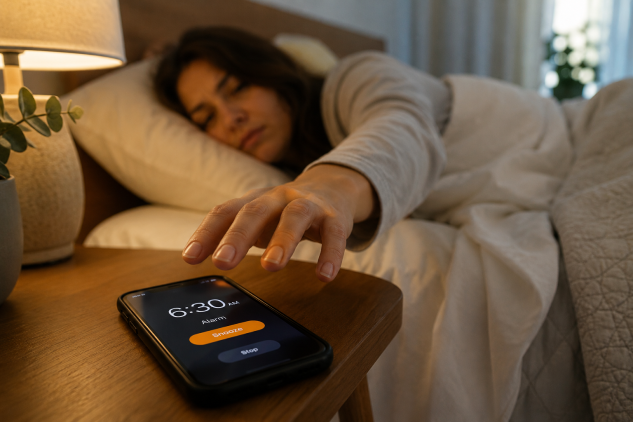
Your internal circadian system has been preparing you for wakefulness.
Light entering your eyes helps synchronize your brain’s master circadian clock with the outside world. As morning approaches, melatonin production falls while cortisol normally rises.
Cortisol gets a bad reputation because we tend to associate it with stress. But cortisol isn’t inherently “bad.”
In a healthy circadian rhythm, cortisol normally rises around waking and helps wake us up for the active part of the day. Think of it as part of your body’s morning boot-up sequence. Your brain is being told that it’s time to wakeup.
That doesn’t mean you’re at your intellectual peak the instant your feet hit the floor. Sleep inertia can temporarily make thinking feel slower. But as sleep fades and your circadian system creates wakefulness, your mental state changes.
And another system is quietly keeping track of how long you’ve been awake.
Adenosine: The “You’ve Been Awake All Day” Signal
While your circadian clock helps regulate when you should be awake, another system keeps track of the amount of time you’ve spent awake. One important molecule involved is adenosine.

As being awake continues, the pressure for your body to sleep, to rest (sleep pressure) builds. Adenosine signaling is part of the process that contributes to increasing sleepiness at the end of your day — or maybe in the middle of it. This is one reason caffeine works.
Caffeine doesn’t create energy out of thin air. It temporarily blocks adenosine receptors, reducing the sensation of sleepiness. And as the day goes along and the hours pass, the balance between your circadian drive for wakefulness and your accumulating pressure to sleep continues to change.
Your Day May Have a Peak, a Trough, and a Recovery
In his 2018 book, When: The Scientific Secrets of Perfect Timing, Daniel Pink pulls together research on chronobiology, psychology, economics, and human performance to make a deceptively simple argument:
When you do something can matter almost as much as what you’re doing.
Pink describes a common daily pattern as:
Peak → Trough → Recovery
For many people, the peak occurs earlier in the day. This is when alertness and mood tend to be relatively high, making it a potentially good time for tasks that require sustained attention and analytical thinking.
Then comes the trough. For many people, this occurs in the afternoon — a period when alertness, mood, and certain aspects of performance can dip. We’ve all looked for the mid-afternoon coffee or sugary drink (or combo) during this time .
And then comes the recovery. Later in the day, some measures of mood rebound, and a different kind of thinking may become easier. But this doesn’t necessarily mean your brain suddenly becomes “better” in the evening, although it may feel like it.
It means different conditions can favor different kinds of thinking.
Pink’s practical recommendation is to match the task to the time:
- Peak → analytical work
- Trough → routine or administrative work
- Recovery → insight and creative work
His research-based framework ultimately suggests that we shouldn’t expect our brains to perform identically from morning to night. And that’s a pretty liberating idea.
NatCurious Note
Daniel Pink’s When: The Scientific Secrets of Perfect Timing is a fascinating exploration of how timing affects our work, health, decisions, and everyday lives. It’s truly one of my favorite books.
Your Best Work Time May Not Be Morning
Here’s where a discussion of chronotypes becomes especially important.
A chronotype is your natural tendency toward earlier or later sleep and wake times. Michael J. Breus, Ph.D., is a double boarded Clinical Psychologist and a Clinical Sleep Specialist (and also known as “The Sleep Doctor”, popularized the four-animal chronotype system — using dolphin, lion (lark), bear, and wolf (owl) — in his very interesting 2016 book, The Power of When: Discover Your Chronotype–and the Best Time to Eat Lunch, Ask for a Raise, Have Sex, Write a Novel, Take Your Meds, and More. (If you are have trouble sleeping, Dr. Breus’ YouTube channel is a must.)
- You may be a morning-oriented person — a “lark or lion.”
- You may be more evening-oriented — an “owl or wolf” You may prefer staying up late, feel most creative or alert at night, and struggle with early mornings.
- Or you may fall somewhere in between, like a Bear: You follow the solar cycle closely; make up the majority of the population and fit best with standard 9-to-5 schedules.
- Or a dolphin: Light sleepers with erratic or easily disrupted sleep patterns who often struggle with insomnia.
And these differences matter.
Pink notes that most people tend to follow the peak–trough–recovery sequence, but a substantial minority — roughly 20% — are more evening-oriented and may experience their best analytical period later in the day. (ICMA) That means telling everyone to do your hardest thinking first thing in the morning isn’t really the great advice. The better advice is:
Find your peak.
Research published in Nature Communications supports this idea. Salehinejad and colleagues found that cognitive performance and measures related to brain physiology were associated with chronotype, with people generally performing better when tested at a time more aligned with their biological preference.
So instead of asking:
“What’s the best time of day to think?”
Try asking:
“What’s the best time of day for my brain to think?”
Why Creative Thinking Can Feel Different Later
Here’s an especially interesting distinction. Analytical problems often benefit from strong focus and inhibitory control — the ability to keep irrelevant thoughts and information out. But insight problems can sometimes benefit from the opposite: When your mind is a little less tightly focused, unusual connections can slip through.

Pink highlights research suggesting that periods of reduced vigilance can sometimes be advantageous for insight problems, even though that same looseness can be a disadvantage for analytical tasks. That’s a fascinating reversal.
The mental state that makes you slightly worse at carefully checking a spreadsheet might occasionally make you better at thinking of creative solutions. Like, “Wait…what if we tried it this way?”
So maybe your evening brain isn’t broken if you can’t do spreadsheets or analyze your finances then. Maybe it’s simply playing a different game.
Evening: Your Brain Begins Changing Gears
As daylight fades, your circadian system begins shifting toward your nighttime body, or physiology.
Melatonin production rises in dim light and helps signal that the biological night is approaching. (That’s why it’s good to move to softer lighting and reduce blue light from devices.)
Melatonin doesn’t simply knock you out, although many taking melatonin supplements think it does. But it’s more like a biological message that it’s time to wrap it up: night is coming.
At the same time, you’ve accumulated hours of wakefulness — and therefore more sleep pressure. So your evening brain is working under a different combination of influences:
Less morning-type wakefulness + more sleep pressure + increasing nighttime signaling.
That’s a very different environment from the one you experienced after waking. And this may help explain something many of us have experienced. And that is that you can be physically tired while your mind suddenly feels surprisingly loose, imaginative, or reflective.
Pink’s peak–trough–recovery framework gives us one way of understanding why, with recovery assisting in insight and creative work.
The Goal Isn’t to Just Become a Morning Person
This is where I think the science gets especially useful. We’re often told to be our best self by waking earlier, working harder or getting more done — using every minute productively. Not only will that lead to overwhelm or burnout, you brain just isn’t a machine that produces exactly the same output from 6 a.m. to 10 p.m.
As we’ve learned, I lot of factors go in to how you perform on what type of task. Factors like timing, sleep, light, circadian rhythm, your chronotype, what you are actually working on — these factors all matter.
Pink’s framework boils it down beautifully:
Match your type, your time, and your task.
This interview from Financial Times with Pink recommends the following:
- If you’re naturally alert in the morning, use that window for demanding analytical work.
- If you’re an evening type, don’t assume your brain is “wrong” because your best work happens later.
- And when the afternoon slump arrives? Don’t think of it as personal failure. Maybe it’s biology.

Try a One-Week Brain Experiment
For the next week, don’t try to become a different kind of person. Just become a better observer of yourself — and jot down what you discover.
- Notice when ideas seem to arrive easily. Notice when you make careless mistakes.
- Notice when your brain feels sharp. Notice when it feels foggy.
You may discover:
Morning: Great focus, poor creativity.
Afternoon: Low energy, excellent time for routine tasks.
Evening: More relaxed, surprisingly creative.
Or you may discover the exact opposite.
And then get curious. Your brain may already be telling you when it does its best work.
Final Thoughts
Don’t just ask what you need to do. Ask when your brain is best suited to do it. Because sometimes the productivity problem isn’t that you’re doing the wrong thing. You’re just doing the right thing but at the wrong time.
And we do have to be realistic here; sometimes when we do tasks isn’t completely ours to control. But maybe team brainstorming meetings should be met in the afternoons as much as possible. Or maybe you do your best analytical stuff in the afternoon, but the report is due at 10 a.m. Having a discussion with your boss about rescheduling this task to mid afternoon might be a good idea.
I mean after all, what supervisor would be unwilling to create an environment where employees do their best at their best time? I know, sometimes I live in a fantasy world, but, hey, it’s worth a try.
Shop This Post
Two excellent books referenced in this post:
When: The Scientific Secrets of Perfect Timing, by Daniel Pink
Keep Learning
For deeper exploration, check out the sources below from peer-reviewed research, trusted health institutions, or other evidence-based articles:
Basheer, R., Strecker, R. E., Thakkar, M. M., & McCarley, R. W. (2004). Adenosine and sleep-wake regulation. Progress in Neurobiology, 73(6), 379–396. https://doi.org/10.1016/j.pneurobio.2004.06.004
Blume, C., Garbazza, C., & Spitschan, M. (2019). Effects of light on human circadian rhythms, sleep and mood. Somnologie, 23, 147–156. https://doi.org/10.1007/s11818-019-00215-x
Breus, M.J. (2016). The Power of When. Little, Brown Spark.
ICMA. (2019, January/February). Timing is everything: An interview with Daniel Pink. PM Magazine.
https://icma.org/articles/pm-magazine/timing-everything-interview-daniel-pink
McHill, A. W., & Wright, K. P., Jr. (2019). Cognitive impairment in humans during circadian misalignment. Current Opinion in Endocrine and Metabolic Research, 5, 87–92. https://doi.org/10.1016/j.coemr.2018.11.003
Pink, D. H. (2018). When: The scientific secrets of perfect timing. Riverhead Books.
Salehinejad, M. A., Wischnewski, M., Ghanavati, E., & others. (2021). Cognitive functions and underlying parameters of human brain physiology are associated with chronotype. Nature Communications, 12, 4672. https://doi.org/10.1038/s41467-021-24885-0
Yamazaki, M., et al. (2023). Diurnal variation in variables related to cognitive performance: A systematic review. Sleep and Breathing, 27, 1861–1874. https://doi.org/10.1007/s11325-023-02895-0