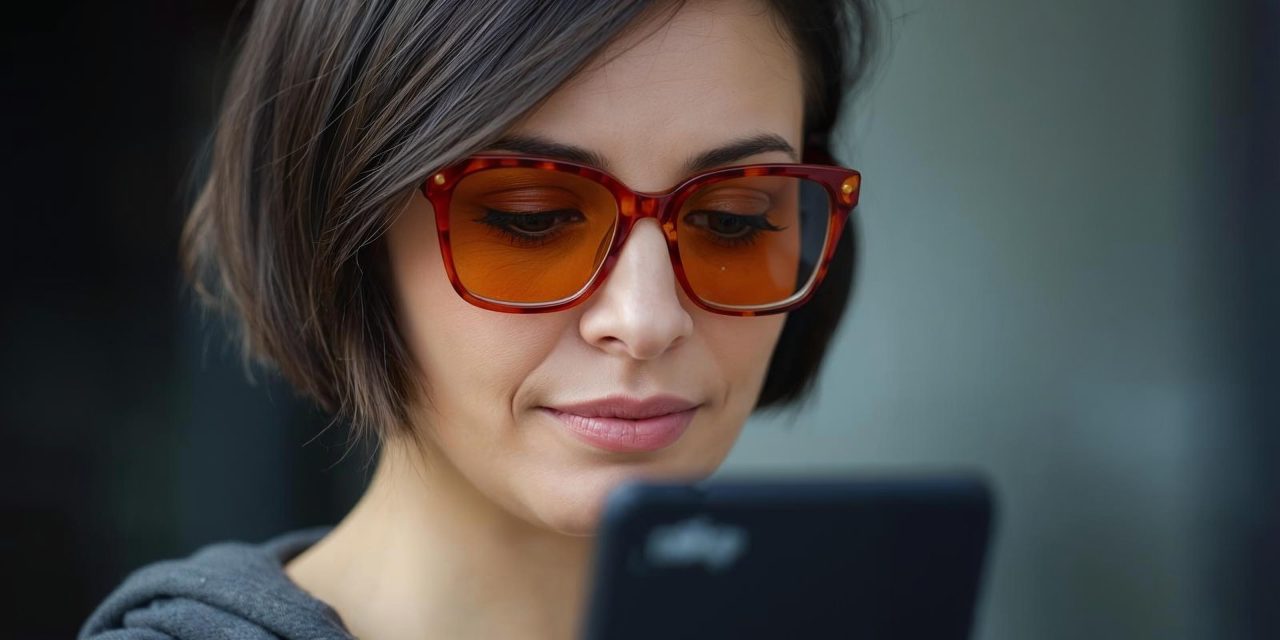
If you’re anything like me, you’re trying to protect your sleep … while also not giving up your nighttime eReader ritual. That cozy, end-of-day reading time feels non-negotiable — but so does better sleep.
So I started wondering: could blue light glasses (sometimes referred to as “blue-blockers”) be the middle ground?
As it turns out, they just might help — at least in certain ways.
First of all, how do blue light glasses work?
Blue light glasses filter out part of the blue wavelengths of light before they reach your eyes. That’s the simple version—but the deeper explanation involves optics, brain chemistry, and circadian biology.
The basics: they filter specific wavelengths.
Visible light includes many colors, each with a different wavelength. Blue light sits roughly in the 400–480 nanometer range, and blue-blocking lenses are coated or tinted to absorb or reflect some of those wavelengths. This is why many blue light glasses look slightly yellow, orange, or red — these can be more effective than clear or lightly tinted lenses.
The biological mechanism: blue light affects your brain, not just your eyes
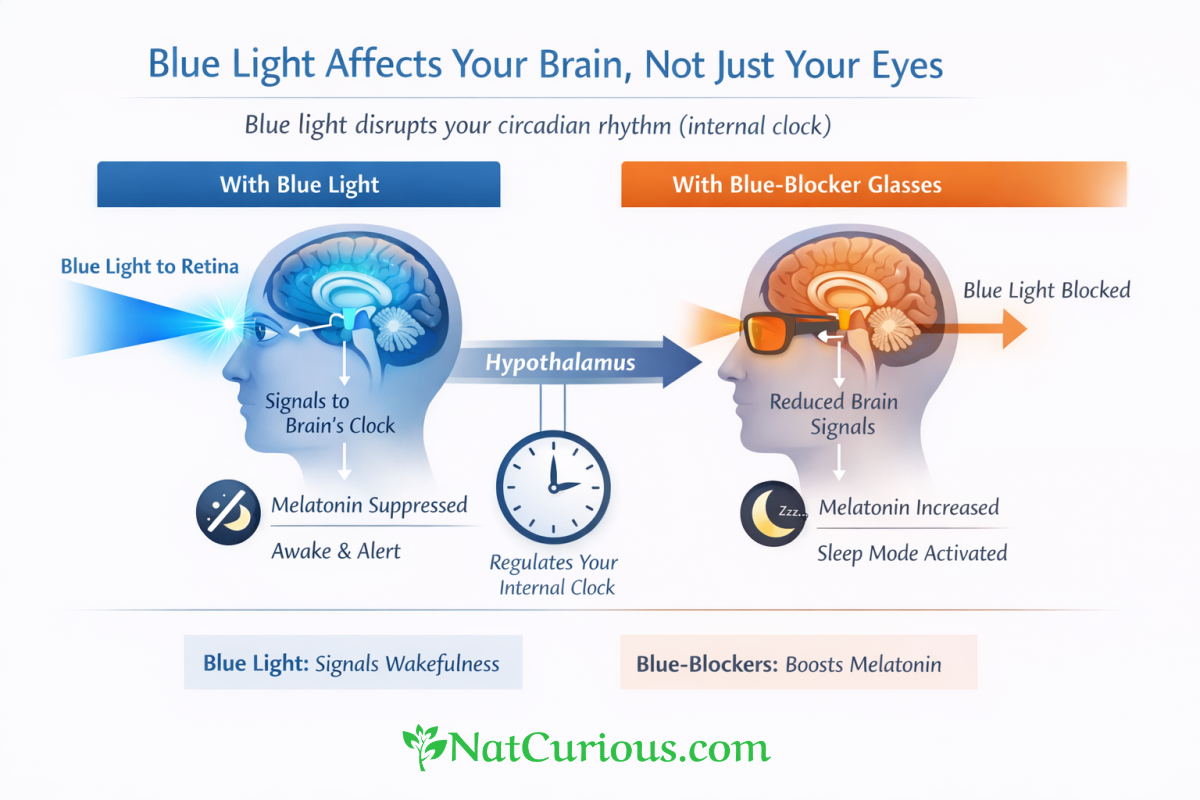
Blue light plays an important role in regulating your circadian rhythm (your internal clock).
Here’s what normally happens:
- Blue light hits special receptors in your retina
- Those receptors signal your brain’s clock (hypothalamus)
- This suppresses the hormone melatonin
- Melatonin suppression keeps you awake and alert
When blue light glasses filter out that blue light:
- Less signal reaches your brain
- Melatonin production increases
- Your brain shifts toward “sleep mode”
This is why they’re often marketed for nighttime use.
What they probably do NOT do: reduce eye strain
Some people turn to blue light glasses to reduce eye strain from staring at screens. Unfortunately, contrary to popular marketing, research shows:
Blue light blocking glasses do not significantly reduce eye strain compared to normal lenses ([Scientific American][5])
Eye strain is mainly caused by:
- Reduced blinking
- Focusing fatigue
- Dry eyes
- Long periods of near work ([Live Science][3])
Not the blue wavelength itself.
Most plausible benefit: improving sleep timing
Blue light exposure in the evening can disrupt your sleep-wake cycle by delaying melatonin release.
Blocking blue light before bed may help your brain wind down naturally.
This is especially true if you:
- Use screens late at night (like me), including TV (not like me).
- Are exposed to bright LED lighting after sunset
- Have circadian rhythm or sleep issues
How to choose a pair of blue-light blocking glasses
At this time, there are no universal regulatory standards governing the term “blue-light blocking.” In other words, it’s largely a marketing label. Because it isn’t strictly regulated, the quality, filtration range, and overall effectiveness of blue light lenses can vary significantly between brands.
When evaluating a pair, look for these specs:
- Clear wavelength specifications — Ideally, the lens should specify its cutoff range, commonly within 400–480 nanometers (nm).
- Stated percentage of blue light filtered —
- Daytime lenses: typically block about 10–30%
- Evening/night lenses: often block 80–100%
- Transparency in testing data — Reputable brands will clearly state which part of the spectrum is reduced and how that was measured.
- Flexible return policies — Individual responses vary, so the ability to test them risk-free matters.
Without standardized labeling requirements or recognized certifications (such as ISO or ANSI benchmarks specific to blue-light filtration), it can be difficult to independently verify whether a lens performs as advertised.
Lens color can make a difference
The amount of blue light blocked depends on the lens color depth and spectral cutoff, but here are evidence-based general ranges:
🟡 Yellow / Light Orange Lenses
Typical blue light reduction: ~10–50%
- Usually filter the higher-energy blue range (around 400–450 nm)
- Often designed for daytime screen use
- Minimal impact on overall color perception
- May reduce glare, but typically do not significantly affect melatonin suppression
Best for: Office work, reducing digital glare, mild comfort support
🟠 Dark Orange / Amber Lenses
Typical blue light reduction: ~60–95%
- Block most wavelengths below ~500 nm
- Significantly reduce light in the melatonin-sensitive range (≈460–480 nm)
- Stronger circadian support in the evening
- Noticeable color distortion (whites appear orange)
Best for: 2–3 hours before bedtime
🔴 Red / Dark Red Lenses
Typical blue light reduction: ~95–100%
- Block virtually all blue light (400–500 nm)
- Often also reduce some green light
- Maximal support for preventing melatonin suppression at night
- Strong color distortion (environment appears red/rose tinted)
Best for: Nighttime use when protecting circadian rhythm is the priority
Why the Difference Matters
Human melatonin production is most sensitive to light in the ~460–480 nm range (the peak sensitivity of intrinsically photosensitive retinal ganglion cells). Lenses that only block part of the blue spectrum may reduce glare but won’t fully prevent circadian disruption.
Choose based on need:
- For work or school: Light yellow lenses reduce harsh glare without distorting color.
- For evening screen use: Dark orange lenses significantly reduce melatonin suppression. This is probably the best choice. It blocks 60 – 95% of the blue light, but you can still see pretty well for most tasks.
- For maximum sleep support: Red lenses provide near-total blue light elimination.
My final take on the blue light matter
When it comes down to it, I believe the dark orange lens glasses may be the most useful for blocking blue light when used within a few hours of your usual bedtime. But still, we need to consider the fact that sometimes the best thing to do is to turn off the devices. Not easy to do, I know. My favorite device is my old iPad with my Kindle app!
Also, consider your caffeine consumption beyond early afternoon as another possible culprit and try to reduce that by going with decaf (which still has some caffeine, but not nearly as much as a regular cup of joe). Another source of caffeine is my beloved chocolate. I refuse to give that up (because I love it AND it has a lot of magnesium), so I have moved that to earlier in the day. High intensity exercise later in the day can sometimes make it hard to wind down on time for bed, but a nice warm soak in the tub or a warm shower can signal snuggle time.
I’m not much of a TV watcher, unless I can find a great mystery, but I do like to read my eBooks. So after my research I’ve decided to be conscious of my caffeine intake, try to squeeze in a relaxing wind down bath now and again, and get a pair of the orange lens blue light blockers for those nights when I really want to read and eBook.
Sleep well, my friends!
Where to find blue light blocking glasses
Amazon has a pretty good selection of blue light blocking glasses. Here’s a link to their collection.